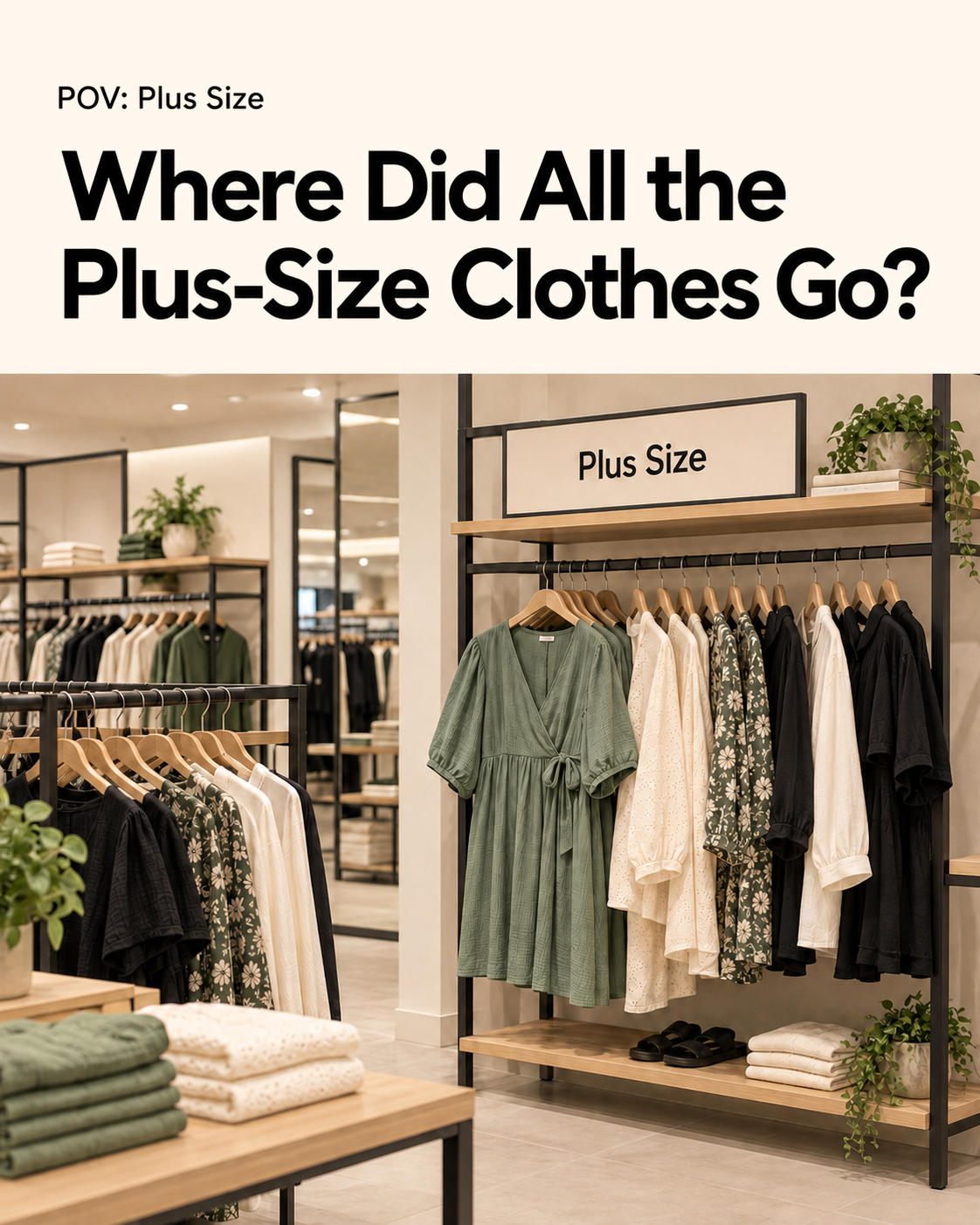
I have been shopping for plus size clothes long enough to remember when certain shops were simply my shops. You knew where to go. You knew roughly what would fit. You could walk in, have a rummage, take an armful into the changing room and, with a bit of luck, come out with something you actually liked. Somewhere along the way, that started to feel much harder.
It is easy to assume that plus size fashion has improved because there are more brands online, more specialist websites and more conversations about size inclusivity.
On paper, there are plenty of clothes.
The problem is what happens when you ask a slightly different question: how much choice do you actually have at your size?
A maximum size does not tell the whole story
Retailers understandably like to advertise the largest size they offer.
New Look still has a Curves size chart running from 18 to 32. River Island publishes a plus size guide covering sizes 18 to 28. George at Asda has launched recent fashion collections in sizes 8 to 24.
Those numbers sound fairly encouraging until you remember that a size range is not the same thing as a wardrobe.
A retailer may technically offer a size 28, but that does not mean every dress, pair of jeans or new-season top comes in a 28. It does not tell you how many styles are available, whether your size is already sold out or whether you will find any of them hanging in your local branch.
The important number is not simply the biggest size on the chart.
It is how many choices are left when you click your size.
The choice gets smaller as the size gets bigger
Even specialist retailers show how quickly that can happen.
Yours Clothing currently advertises clothing in sizes 14 to 40 and, compared with most mainstream retailers, offers an enormous plus size range.
But look at its casual tops by size and the difference becomes visible.
At the time of checking, there were around 1,300 styles showing for a size 24. At size 26 that fell to just over 1,100. Sizes 30 and 32 had fewer than 1,000. By sizes 34 and 36, the choice was around 430, and sizes 38 and 40 showed roughly 275.
That is still considerably more choice than many retailers provide.
It also demonstrates why saying “we go up to a size 40” only tells part of the story.
The door may technically be open all the way to a 40. The shop gets considerably smaller as you walk through it.
Then there is the high street
Online shopping has undoubtedly given plus size women access to clothes we might never have found locally.
But I am not convinced that sending everything online should automatically be treated as progress.
New Look tells customers that its full online range can be ordered through any store if the item or size they want is not available there. That is useful. It is certainly better than being told there is nothing available at all.
But ordering something is not the same experience as trying it on.
You cannot hold two sizes against yourself. You cannot feel the fabric before buying it. You cannot wander back out of the changing room and grab a different pair of trousers. You cannot go shopping with a friend and actually participate in the same way if their clothes are upstairs and yours are somewhere in a warehouse.
The transaction still exists.
The shopping experience has disappeared.
Size 24 can feel like a cliff edge
This is particularly noticeable once you get into the mid-twenties.
George's recent Style Stories collections, for example, have been advertised up to a size 24. River Island's plus size guide reaches 28. New Look Curves reaches 32.
Then there are specialist retailers such as Yours and Evans offering sizes well beyond that.
None of those retailers is doing anything wrong simply because its range has a limit. Every clothing company has one somewhere.
But collectively, those limits matter.
A woman wearing a size 20 or 22 can potentially shop across mainstream collections, plus size ranges and specialists.
At 24, some of those doors start closing.
At 26, more disappear.
By 30 or 32, the shopping map looks completely different.
And that is before considering personal style, budget, height, proportions, disability, fabric preferences or the fairly reasonable desire not to buy something simply because it happens to fit.
I don't want access. I want choice.
Perhaps that is the part of size inclusivity that gets lost.
I do not want to be congratulated because somewhere on a website there are seventeen things technically available in my size.
I want to dislike twelve of them.
I want to think one is too expensive, one is an awful colour, two are not my style and another makes me look like I have joined an experimental theatre company.
That is what everyone else gets to do.
Fashion is supposed to involve taste.
When the available selection becomes small enough, shopping stops being about what you want and starts becoming a hunt for what you can get.
Plus-size clothes have not vanished.
But for women at the upper end of plus size ranges, they have been concentrated into fewer retailers, fewer styles and increasingly into an online shopping experience.
Maybe the better question is not “Does this shop sell my size?”
It is:
“If it does, do I get enough choice to actually be choosy?”
More from POV: Plus Size